
Identify a Lauderdale County Owner
A Lauderdale County parcel owner is confirmed by joining two records, never by trusting a single name on a screen. The roll comes first. The Real Property Appraisal Inquiry supplies the roll name, property address, mailing address, PPIN, legal description, and deed history. The Chancery Clerk supplies the recorded transfer. Keep the PPIN and the deed book and page beside the name itself. They separate the intended tract from a same-name owner.
- Enter the street number and street name in the appraisal inquiry. If that fails, try the road name alone or use the PPIN, parcel number, or section, township, and range.
- Read the exact OWNER NAME field. Copy the PPIN, property address, legal description, and newest deed book/page at the same time.
- Open the Lauderdale Chancery land-record inquiry. Locate the latest instrument by book/page, parcel data, or the roll owner's name.
- Check that the grantee, legal description, and parcel clues match. If the deed is newer than the roll, treat the deed as the stronger just-closed confirmation.
The route identifies the record owner only. It says nothing about who occupies the site, and for a fuller look at the exact present-roll fields, use the current property owner record.
Lauderdale County Owner Field
The appraisal card labels its answer OWNER NAME. Mailing address and property address get separate labels. That split matters more than it looks. The property address, called the situs, locates the land, while the mailing address is where tax correspondence goes and may be a post office box, another county, or an old address. Neither address proves the named person lives at the parcel.
The sample card links the owner entry to a PPIN, a long parcel number, acreage, a legal description, and deed-history rows. Those fields make the result testable. Delta warns that uploads may lag courthouse activity. Lauderdale County publishes no exact refresh schedule. Always save the year shown with the result.
The officially linked sample parcel card shows how the roll separates owner, mailing, situs, and deed data.
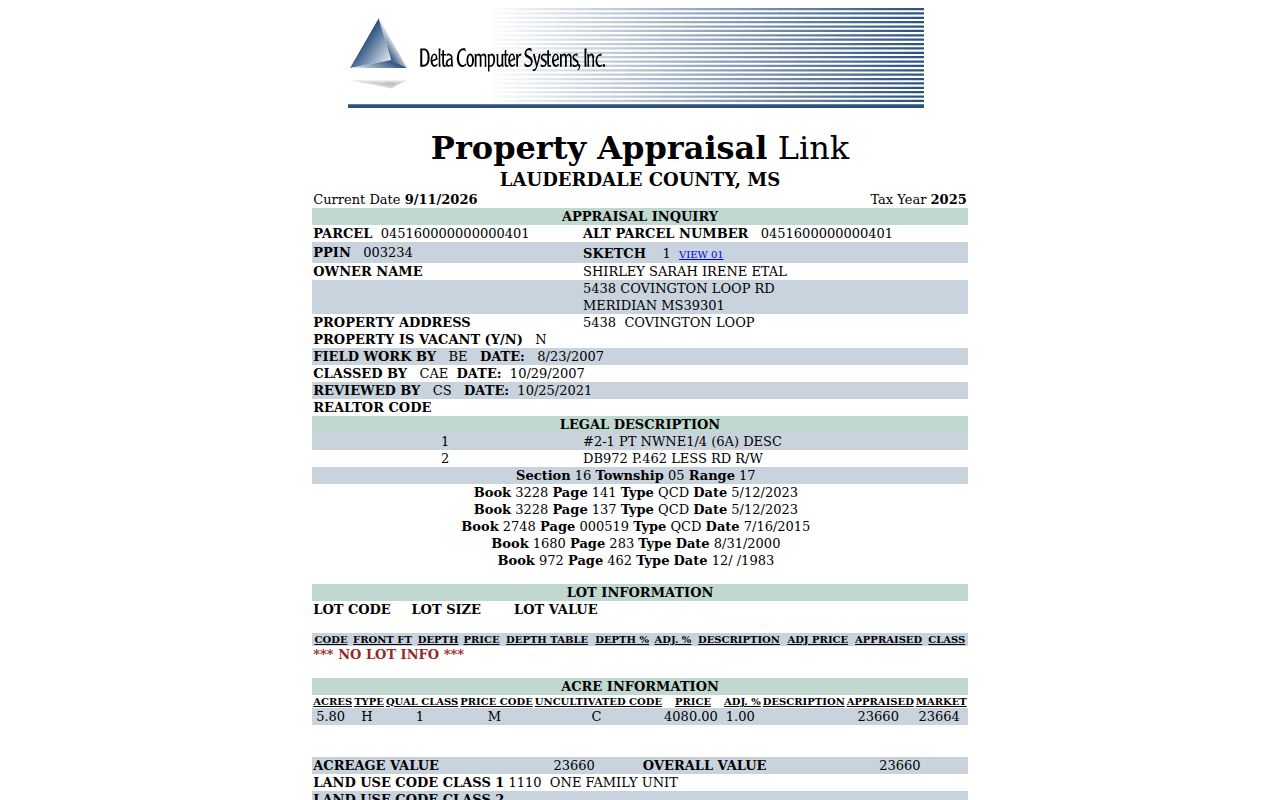
A name alone is a weak answer. The sample parcel card shows how the PPIN and deed rows bridge the roll to recorded proof.
Trace Lauderdale Ownership to Deeds
A recent sale starts two clocks. The Chancery Clerk allows same-day viewing of recorded documents. The appraisal host's uploaded file may trail courthouse work. When the question is who owns a parcel after a closing, rely on the newest deed's file date and grantee. Then compare the legal description, PPIN, parcel number, and any related instrument against the roll.
The online Chancery index is still useful. The portal calls the courthouse Land Records Index official. The Clerk's land-record counter is at 2600 Courthouse Boulevard, Room 1079, Meridian, and deed questions go to 601-482-9701. County material also mentions public inspection at 500 Constitution Avenue. Call before making the trip. When an online result is absent or unclear, counter access and the official index remain the fallback.
Note: A blank online result may reflect coverage or indexing rather than the absence of a recorded ownership instrument.
Lauderdale Property Ownership Sources
Each official source answers a different part of the ownership question. The roll gives the administrative name used for appraisal and tax work. Chancery records the conveyance. GIS ties the identifier to a map polygon. Entity records can clarify the legal organization named as grantee, but they do not reveal every person with an economic interest.
| Ownership source | Useful answer | Best route |
|---|---|---|
| Appraisal roll | OWNER NAME, mailing address, situs, PPIN, and deed references | Delta inquiry or assessor counter |
| Chancery land index | Grantee, grantor, file date, book/page, instrument, and legal description | Online inquiry or official courthouse index |
| County GIS parcel layer | Owner display name tied to a parcel polygon and PPIN | Current viewer, REST layer, or GIS request |
| Secretary of State | Business filing name, officers, and registered agent when available | State business search |
An owner may be one person, several people marked ETAL, a trust, an estate, or an LLC. Search the Chancery name exactly as indexed. Then broaden the variants. A matching officer or agent name is only an entity clue, and the deed remains the source for the conveyance.
Use Lauderdale PPIN as Check
Lauderdale County uses several identifiers for the same tract. Preserve each format exactly. A portal may expect one form and reject another. The appraisal card shows the PPIN with leading zeros, while GIS may display the same key as a plain number, and the long parcel number also appears in alternate forms. Copy what each system shows before changing anything.
The PPIN earns its keep when an owner name is common, abbreviated, or loaded with ETAL. Match it against the deed book and page. Add the legal description too. Names alone should never join two records. For rural land, section, township, range, quarter calls, acreage, and right-of-way language can supply the stronger match.
If one search fails, try the stored version from the other official result. Do not assume the tract vanished. A PPIN stored with leading zeros may be the only form a given portal accepts. The same care applies across every Lauderdale County property search.
Street data needs the same patience. The situs may omit a road suffix that appears in the owner's mail line. Rural deeds may not carry the current road name at all. Start with the address for speed, but let the PPIN, deed reference, and legal description decide whether the owner result belongs to the intended land.
Identify Lauderdale Entity Owners
The roll sometimes names an LLC or a corporation. Copy the spelling exactly. Then run the name through the Mississippi Secretary of State business search, which supports business name, business ID, officer, and registered agent lookups. Match the entity status and filing name against the grantee shown in the deed.
Trusts and estates take a different trail. Search trust, executor, executrix, estate, and individual name variants in Chancery, where a probate or court order can explain a name chain that shifts without a simple arm's-length deed. Full court access may require Mississippi Electronic Courts registration or a clerk terminal. No entity database substitutes for the title records themselves.
Chancery indexes far more than plain deeds. Its instrument list covers trusts, powers of attorney, executrix's deeds, life-estate deeds, corrections, and many other forms. A name inside one of those records does not always become the property owner. Read the parties, the instrument type, related instruments, and the granting language. The legal description must still match the same parcel.
Several named people need care. Do not collapse ETAL into one owner. Pull the complete instrument and note how each grantee is stated. The appraisal roll may shorten a long ownership line for display, while the deed image preserves the recorded form for Lauderdale County parcels.
- Owner of record
- The name carried on the county's administrative property roll.
- Grantee
- The party receiving an interest in the recorded instrument.
- Title
- The legal ownership interest, which a full title review evaluates beyond one online result.
- Situs
- The physical property location, distinct from the owner's mailing address.
Monitor Lauderdale Owner Names
The Chancery Clerk offers a free watch service. Its Property Fraud Detection and Alert page registers a person or company name. It sends notice when a new instrument is indexed under that name. It can flag a filing worth review. It does not certify title, block recording, or guarantee a match on every name variation.
There is a privacy tradeoff. The signup warns that notification email addresses become public records unless an exemption applies. Enter useful name variants. Send questions about a hit to the Clerk. Then verify the match against the actual instrument before drawing conclusions.
Alerts work best after the owner of record is verified. One spelling may miss a company suffix. It may also miss a middle initial, a joint owner, or a trust variation. A notice means a name matched a newly indexed instrument. It does not mean fraud occurred. It does not replace a periodic check of the recorded deed trail in Lauderdale County.
Cross-Check Lauderdale Property Owners
The Lauderdale parcel layer adds a spatial cross-check. Its OWNERNAME display field sits beside PPIN, parcel ID, situs, acreage, deed date, book/page, tax district, and legal-description text. Search the subject tract by its saved identifier. Compare those fields with the appraisal card. Agreement across both systems strengthens identification of the tract. GIS is still not a title record.
Remember what the map is. It exists for tax purposes and is not a legal survey or document. A polygon may be generalized. A displayed owner can sit on a different update cycle from the appraisal roll or Chancery index. If the owner names differ, compare deed dates and access dates. Do not pick the map name just because it is easier to see.
Reach Lauderdale Ownership Records Offline
Each documented channel has its role. The web appraisal and Chancery inquiry are the fastest start. The assessor counter handles roll or mapping questions. The Chancery land-record counter supplies the official index and certified records. County Archives, MDAH, and the FamilySearch catalog help with an older ownership trail. A written public-record request is the last broad fallback. Use it when a known county record is not exposed online.
Prepare before calling or visiting. Bring the situs, owner spelling, and PPIN. Include every parcel-number form, legal description, appraisal year, and newest deed book/page. Ask which office holds the named record. Ask whether a plain or certified copy is needed. Portal payment and subscription terms sit apart from county request fees. Get a current quote from the custodian.
For Meridian or Marion land, municipal permits can add building or zoning context. The cities still do not replace Lauderdale County. Lauderdale County remains holder of the appraisal, GIS, tax, and deed records. Confirm the owner of record through county sources first.
Limits on Lauderdale Owner Findings
A public roll name has limits. It does not prove who lives in the house. Nor does it show who stands behind a corporate owner. Title is not confirmed clean by it either. The GIS map serves tax-reference purposes only, and a legal survey it is not. Mailing addresses can be protected, swapped, or just unconnected to the parcel's situs. Mississippi runs an Address Confidentiality Program that gives qualifying victims a substitute address. That protection should be respected, never worked around with other records.
Online hits sometimes dead-end. When they do, call the assessor or visit the Chancery counter. Another route is a narrow written request through the county records request form. Lauderdale County does not perform research for you. It fills requests within seven working days. Stated copy or actual-cost fees may apply. List the department, the PPIN, record type, names, date range, and the format you want.
Older ownership questions need other routes. The Virtual Historic Index works from book and page. FamilySearch catalogs Lauderdale deeds from 1837 through 1886 on microfilm. MDAH holds county-record and selected tax or land series. Lauderdale County Archives can round out the local history. These sources shine when a modern owner trail points back to an old parent tract. Even so, the Chancery deed stays the legal conveyance source.
Note: Keep an as-of note with every result, logging the appraisal year, the deed file date, and the source type, whether index, image, roll card, GIS attribute, or certified copy.
Use owner records with care. A roll name is not a title search, and ownership may sit in a trust or LLC. Lauderdale County owner data is for lawful property research, never harassment, targeting, or harm.